1994
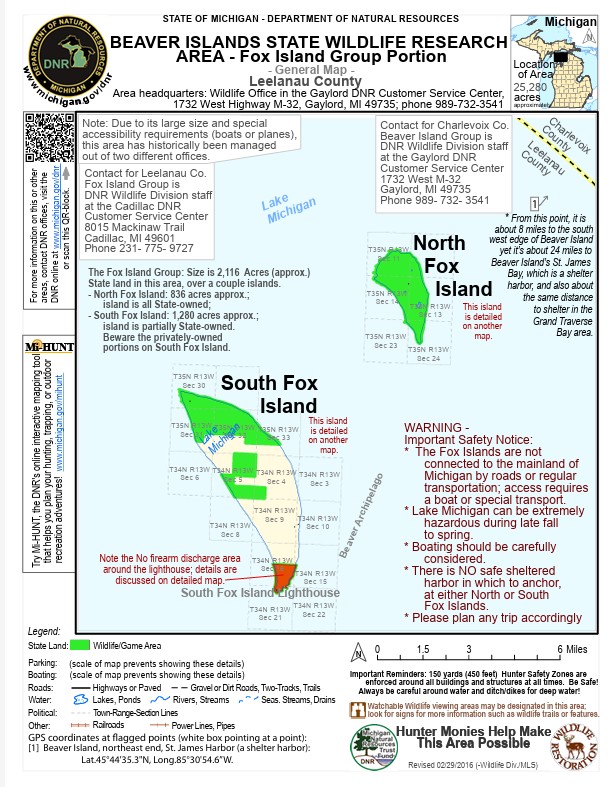
- David V. Johnson purchases North Fox Island after another party proposed building a $100 million, 642-unit luxury housing project on the island. “I couldn’t stand by and watch North Fox Island be destroyed,” Johnson told the Traverse City Record-Eagle.
1995
- The Natural Resources Commission announces the possible acquisition of North Fox in a trade with Johnson, who also owns two-thirds of South Fox. Johnson proposes trading the entire 832 acres on North Fox to the state in exchange for the remaining third of South Fox, which the state owns. Total land in public ownership is 1,140 acres.
1996
- The Grand Traverse Band of Ottawa and Chippewa Indians opposes the proposal, citing ancestral ties to the island, a tribal cemetery, and treaty rights to hunt, fish, and gather vegetation on public land in areas its ancestors ceded to the government in an 1836 treaty. DNR’s district office opposes the swap, saying South Fox is more important than North Fox for ecological reasons, public recreation, and accessibility.
1997
- In view of much public opposition, the DNR rejects Johnson’s swap proposal. Instead, DNR director K.L. Cool proposes the purchase of North Fox. In December, the state’s Natural Resources Trust Fund approves the purchase for $2 million for use as a natural area open to public access and for ecological research.
2000
- The Grand Traverse Band offers to take ownership of the south tip of South Fox Island, including the former light station. The federal government rejects the proposal, citing the 1949 Federal Lands to Parks law, which does not mention tribes as possible recipients.
- DNR files a request to allow a road to be built through critical dune land on South Fox to enable repairs to the light station. According to the land swap draft, Johnson would have to restore and maintain the lighthouse. Opponents fear the road would be used to link Johnson’s house to the lighthouse and the southern beach area.
2001
- Despite strong opposition from a standing-room-only crowd, the Leelanau Township Planning Commission recommends that the Leelanau Township Board not oppose the special exception permit for the construction of the road on the island. The DEQ cannot issue the permit unless the township approves.
- The Michigan United Conservation Club board adopts a resolution opposing the land swap between David Johnson and the State of Michigan swapping N. Fox for plots on S. Fox to allow more concentrated property. In March, the Leelanau Township Board votes to oppose the road permit, leaving the swap issue unresolved.
- In September, the DNR bans hunting on the southernmost 115 acres of South Fox to prevent vandalism to the historic lighthouse.
- In December, the DNR and Johnson eventually reach a swap agreement that does not include the 115 acres transferred to the state in the 1970s. The Grand Traverse Band files a lawsuit against David Johnson opposing the deal, citing the tribe’s treaty land claims on the island.
2002
- The Michigan Land Use Institute joins the Grand Traverse Band’s lawsuit, stating that the DNR did not follow its own policies for transferring state lands.
- State Attorney General Jennifer Granholm rules that she cannot approve the swap because of Indian land claims that “cloud” the title on 200 of the 219 acres to be traded.
- David Johnson files a counter-suit against the Grand Traverse Band and the Michigan Land Use Institute.
- In November, Leelanau Circuit Court Judge Thomas Power rules against some of the tribal claims. This clears the “cloud” over the title and allows the swap to proceed.
2003
- The Michigan Land Use Institute holds a forum in Traverse City in an attempt to drum up opposition to the land swap. However, on March 7, Attorney General Mike Cox certifies the transfer.